
There’s nothing worse than spending money to upgrade your electric scooter and then realizing the new one really isn’t much better than the old one.
You wanted the wow factor:
More speed. More range. More comfort. More power. Or at least something that made the new scooter feel like you got an unmistakable upgrade for your money.
Instead, you got a scooter that is just slightly different.
That's what this article is about: not just when to upgrade your electric scooter, but how big of an upgrade you need before you actually feel the difference.
Because if you’re spending your hard-earned cash, your next scooter shouldn’t leave you wondering if the new one is really better. It should be a slam-dunk upgrade that makes you smile every time you ride it.
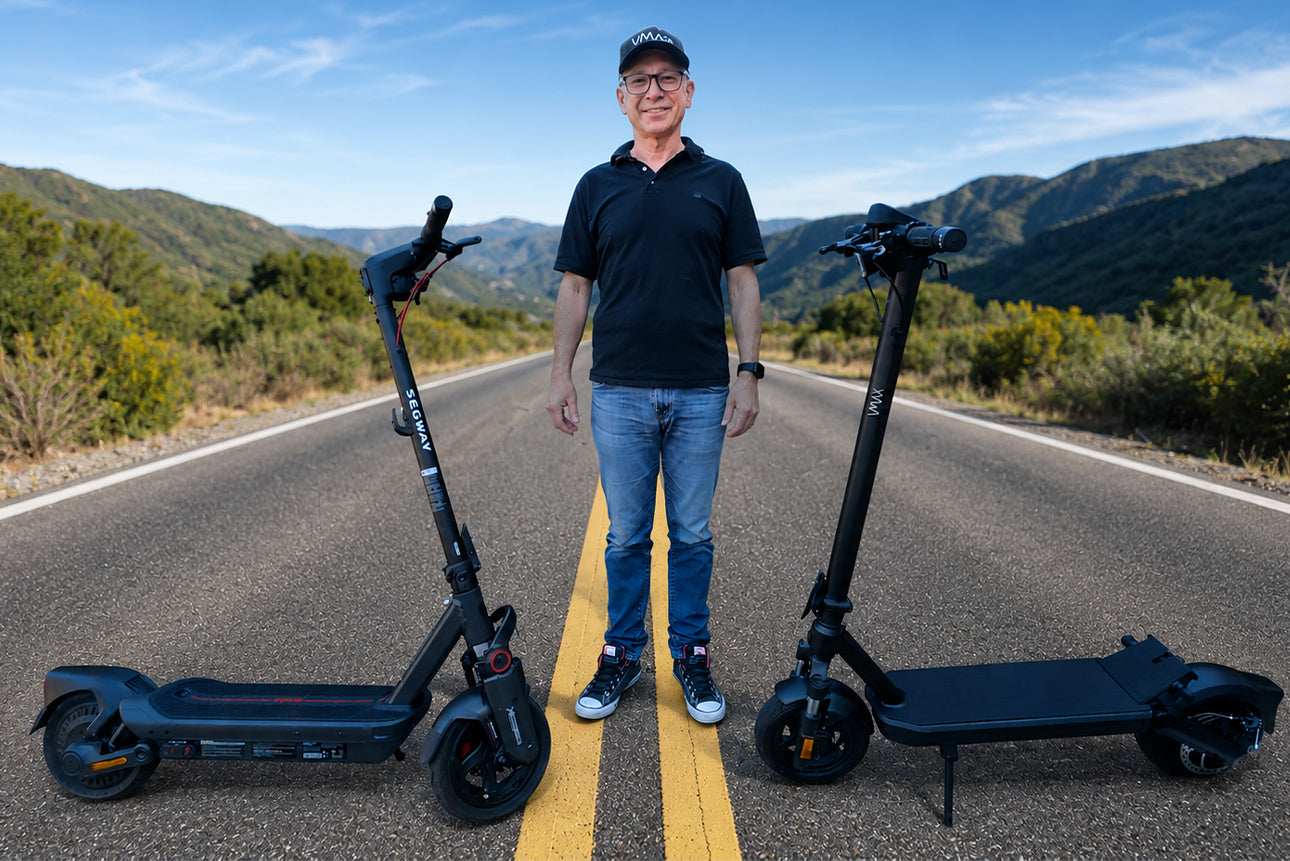
Paul with the Amazon scooter and Costco Phantom GoGo A10 side by side.
The $199 Amazon Scooter vs. the $399 Costco Scooter
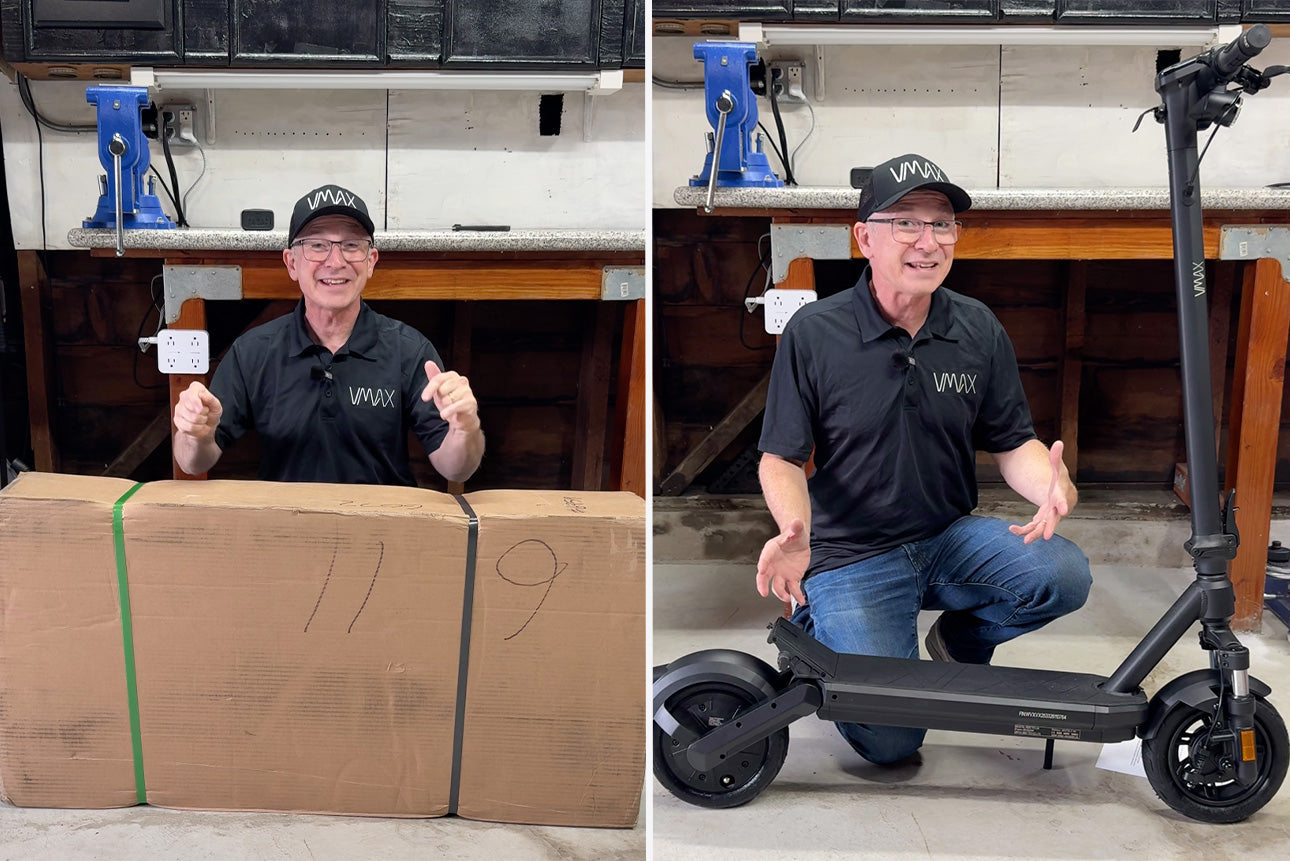
So, for this test, I decided to do a “Cheap Scooter Upgrade” I bought the best-selling $199 scooter on Amazon, the Maxshot V1 Sportscooter about a year ago and fully tested it. Then this year I bought the best-selling scooter at Costco, the $399 Phantom GoGo A10.
On paper, this looks like an obvious upgrade.
The Costco scooter costs about twice as much. It is bigger. It looks more adult-sized. It feels like it should be in a different class.
So the obvious question is:
If you start with the $199 Amazon scooter and spend twice as much to “upgrade” to the $399 Costco scooter, do you actually get a noticeably better scooter?
I tested both scooters using the exact same scientific tests I used during my four years as the lead scooter reviewer at Electric Scooter Guide, where I tested more than 200 scooters.
And the results were surprisingly… underwhelming. But keep reading, because I’m going to help you avoid making the mistake I made!
The Test Results

The $199 Amazon scooter hit 18.0 mph.
The $399 Costco Phantom GoGo A10 hit only 15.3 mph, which to be fair is very close to its 15.5 mph spec.
So the Costco scooter costs twice as much, but it is actually slower.
Range was a little better for the Costco scooter, but not by much.
On the same Electric Scooter Guide range-test-course, riding both scooters in sport mode, the Amazon scooter went 12.1 miles. The Costco Phantom GoGo A10 went 14.2 miles.
So the Costco scooter went 17% farther (+2.1 miles), but at twice the price.
It’s a real, measurable, difference. But it is not the kind of upgrade that makes you say, “Wow, this is a totally different class of scooter.”
Hill climbing told the same story.
The Amazon scooter averaged 4.3 mph climbing the ESG test hill. The Costco Phantom GoGo A10 averaged 4.9 mph on the same hill.
Again, technically better. But even as an expert rider, the difference in hill climbing speed was so small, they felt the same.
But there is one difference you’ll definitely feel: the weight.
On my test scale (calibrated to match the one I used at Electric Scooter Guide) the Amazon scooter weighed 26.1 pounds. The Costco scooter weighed in at 41.4 pounds.
That is a 15.3-pound weight difference: 59% heavier!
If you carry your scooter up stairs, lift it into a trunk, bring it into an apartment, or carry it onto public transit, 15 pounds is not a small difference. No matter how strong you are it’s a difference you’ll feel every time you lift it.
To be fair, the Costco scooter has one advantage I could really feel and that’s its size.
The deck is bigger. The handlebars are higher. The whole scooter feels more adult-sized. Of these two scooters, the Phantom GoGo A10 is absolutely the better fit for adult-sized riders. The Amazon scooter was noticeably too-small for my 5’10” frame during the range test.
But is that enough for me to recommend it as the next step up from the $199 Amazon scooter? It’s not.
The bigger size is nice, but the performance boost just is not noticeable enough. After fully testing them both, I feel like I spent twice as much money on a bigger version of basically the same scooter.
But keep reading, because here’s how to avoid making the mistake I did.
How to upgrade if you want guaranteed wow-factor.
Rule #1: How Much Faster?
Let’s start with everyone’s favorite upgrade: top speed.
Top speed has a very simple rule of thumb:
If you want to feel a meaningful upgrade, add about 10 mph.
Going from 15 mph to 25 mph I guarantee you’ll feel the wow-factor.
The same is true going from 25 mph to 35 mph. Or from 35 mph to 45 mph.
A 5 mph difference feels “somewhat faster” but a 10 mph boost is where you really feel like you’ve leveled-up when upgrading scooters.
Even if you don’t use all of that top speed, you’ll still feel the difference. Higher top speed usually comes with better acceleration. It also means you are not riding around with the throttle pinned at maximum all the time. The whole scooter feels more relaxed and effortless because it has more performance in reserve.
That said, there is a practical limit.
Top speeds above about 35 mph are not useful for most riders most of the time. Battery life gets much shorter above 25 mph, there are not many places where you can safely ride a scooter that fast, and there’s that thing called the speed limit.
But, use-it-or-not, it’s fun having your thumb on the throttle of a fast scooter just knowing the power is there if you want it.
Just remember: if you have the need for speed, you’re going to need to bump it up 10 mph when you switch scooters to feel like you made a real upgrade.
Upgrade Rule #2: Switch From Solid Tires to Tubeless Air-Filled Tires
The number one biggest upgrade you can make in terms of ride quality and traction is switching from a cheap scooter with solid tires to a quality scooter with air-filled tubeless tires.
This is one of those upgrades you feel immediately.
Tubeless air-filled tires ride much smoother than solid tires. They also give you a lot more traction, which means better cornering, better braking, and a more controlled ride.
If your current scooter has solid tires and you switch to a scooter with good tubeless pneumatic tires, your ride quality changes from “cheap toy” to “real commute vehicle”. It sounds like an exaggeration, but trust me when you try it, the difference is obvious.
What about tire size?
After testing more than 200 scooters, here is my hot-take: you can really feel the difference between 8-inch tires and 10-inch tires, but the difference between 10-inch tires and 11-inch tires is much more subtle. I'd literally have to read the sidewalls to know for sure which size I'm riding. Most of the difference I feel actually comes from the fact that many 11” tires are also much wider.
Are there scooters with 12-inch tires? There are, and I’ve tested them. Twelve-inch tires can help if offroad is your main use-case. But the tradeoff is portability. Scooters with 12-inch tires generally will not fit in the trunk of your car without folding down at least one seat. For me, that’s a key difference, especially if I need to move my kids and a scooter in the same car.
One more tire note: if you already have tubeless tires, a really fun upgrade to try is switching from the original tires to Italian-made PMT tires. I should also point out that this is the one upgrade in this blog post that you can make *without* switching scooters!
PMTs have more grip and better road feel. I’ve raced on PMT’s but even for regular road riding they’re a very noticeable upgrade. Make sure you research the right size and tread compound before buying. There are a couple big importers of PMT’s in the USA and they’ll be happy to help make sure you get the exact compound and size you need.
Upgrade Rule #3: Add Good Suspension, Not Cheap Suspension
The next meaningful upgrade is switching from an electric scooter without suspension to a scooter with suspension.
If you’re regularly riding distances of more than 5 miles or sustaining speeds of more than 20 mph, then suspension is an upgrade worth considering.
But here hot-take #2:
Having cheap suspension is worse than having no suspension at all.
Some scooters technically have suspension, and that looks great on the spec sheet, but the ride is still terrible because it consists of springs without proper damping.
Just like in a car or motorcycle, good suspension needs two things: a spring and a damping device to keep it from bouncing up and down forever after you hit a bump.
To be clear, I’m not talking about steering-dampers here, but an oil-based shock absorber integrated into your suspension that stops you from bobbing and bouncing along as you ride.
If you’ve got a scooter with springs, but no damping, you’re basically riding a pogo stick with wheels!
In contrast, the suspension on VMAX scooters uses a motorcycle-style fork up front with internal springs and oil damping. In the rear, VMAX uses self-damping elastomeric suspension. It’s a compact block of rubber which acts as both spring and damper in one.
So if you are going to upgrade to suspension, make sure it’s good suspension. Otherwise, you’re paying extra for something that’s just making your scooter worse! (and heavier)
Suspension can completely change the way a scooter feels, and good suspension definitely brings the wow-factor when you upgrade.
Upgrade Rule #4: Double Your Peak Power
Now let’s talk about the most complicated subject of all: power.
People want more power for two main reasons: acceleration and hill climbing.
More power means you get up to speed faster when the light turns green, or stop sign to stop sign, and your scooter doesn’t run out of speed on steep hills.
But scooter power is confusing because most companies list two different numbers: nominal power and peak power.
Here is rule number one:
Nominal power means *nothing* because every manufacturer defines it differently.
The number you should care about is peak power.
Peak power is what you feel when you accelerate or climb hills.
Best of all, everyone agrees how Peak Power is calculated! Ohm’s Law makes this pretty clear: it’s peak battery-voltage multiplied by the maximum current from the motor-controller.
For example, the 34 mph VMAX New VX2 Hub has a 48V battery. Fully charged, that battery is 54.2V. Multiply 54.2V by a 35A controller, and you get about 1,900 watts of peak power from a single rear motor.
So how much more peak power do you need to really feel a difference?
That’s easy: Double it!
That may sound insane, but trust me, if you want to feel the difference it’s what you’ve got to do. If you are upgrading from a scooter with 500 watts of peak power, you want around 1,000 watts of peak power.
If you have 1,000 watts, you want to jump to around 2,000 watts.
Scooters at any power level can be fun. But if you are looking for the wow-factor, just like with audio systems, doubling peak power is where the upgrade becomes unmistakable. (and fun!)
Peak Power = V(volts) x I(Current)
Upgrade Rule #5: Add About 10 Miles of Real-World Range
The more experienced you get as a rider, the farther you want to ride.
And nothing ruins a fun ride more than range anxiety.
Range-anxiety is a real thing. It sucks the fun out of your ride. It makes you slow down, turn around early, and kills your care-free enjoyment of the scooter.
So range is one of the top reasons people choose to upgrade to a new scooter.
But how much more range do you need if you want to feel a truly enhanced sense of freedom. If you want to feel unleashed?
First, remember that most advertised scooter range numbers are based on eco mode riding. If you ride in sport mode (don’t we all?), a good rule of thumb is to divide the advertised range by two.
Now for the upgrade rule:
If you want to really feel a meaningful range upgrade, add about 10 miles of real-world range.
If your current scooter gets 10 or 12 miles in real conditions, upgrade to something that can do an honest 20 miles.
If your current scooter gets 20 real-world miles in sport mode, look for something that can do around 30.
So, the crazy thing is that if you go back to what I said earlier, it means you’ve got to bump your spec-range up by about 20 miles to get that meaningful 10 mile difference. But if you’re already fighting range anxiety, just do it: get the scooter with the big battery. I’ve never regretted buying a scooter with a larger battery, but I *have* regretted buying a scooter with a smaller battery.
On the other hand, if you’re only riding a mile or two at a time, and you’re only charging once a week, then you already know you don’t need more range… but read on because I’ve still got some great upgrade suggestions for you!
I should point out that range testing is not standardized, so comparing specified-range can be tricky. One scientific way to compare scooters is to look at battery size in watt-hours. Please don’t make the common mistake of looking only at amp-hours. Amp-hours alone will not tell you much without factoring in voltage as well.
Watt-hours, on the other hand, let you accurately compare batteries apples-to-apples, accurately across scooters of any voltage.
So let’s look at Watt-hours. If your current scooter has a 499Wh battery and gets about 20 miles of real-world range, then moving to a scooter with a 768Wh battery (roughly 50% bigger) should get you roughly 50% more range as well, assuming the scooters are similar in top speed.
But keep in mind if you are also increasing top speed in the same upgrade, you’re going to need to bump up the battery size a little more because faster riding burns through energy much faster.
When Should You Upgrade?
So we’ve covered what to upgrade, and by how-much.
Now let’s talk about the “when.”
My rule is simple:
Don’t upgrade just because a new scooter came out, for example Ninebot MAX G2 to G3.
Upgrade because your riding has changed in a specific way.
Upgrade because your skills have leveled-up and your current scooter is holding you back.
Because your commute got longer and you need more range.
Maybe you’ve lost your tolerance for creeping up hills at 4-and-a-half miles per hour.
Or, maybe you started carrying more gear, riding farther, and your scooter is starting to feel like something that could really replace your car, if you just had a little more: _____.
When you start regularly bumping into the limits of your current scooter, *that* is when it is time to start thinking about the next one.
The Bottom Line
So let’s come full circle to the Costco vs. Amazon comparison because it’s a great example of where upgrades go wrong.
When you spend twice as much on anything the wow-factor should be a slam-dunk, but unfortunately it’s not. I fell for it too. Even after testing 200 scooters, I was sure I’d find some sort of noticeable difference when testing these two scooters, other than size. But this is such a great example of why you really always have to pay attention to reviews and scientific testing (where you can find it)
The $399 Phantom GoGo A10 was bigger. It was way more expensive. It looked more adult-sized. It even looked like it might have rear-suspension (it doesn’t).
But in the actual tests, it was slower, only slightly better on range, only slightly better on hills, and much heavier.
That is the lesson.
Spending twice as much money does not guarantee you are going to get wow-factor.
If you are thinking about upgrading, you’re always going to have some sort of budget in mind, but before you lock in, simply start with the #1 thing you want from your current scooter that it’s not giving you and let that guide you to the starting point of your search.
Is it too slow? Look for about 10 mph more top speed.
Are you riding faster or farther? Consider a scooter with good suspension or 20 more miles of spec range.
Does it struggle on hills? Look for roughly double the peak power.
It’s also astute to look at where a scooter is engineered. I don’t want to sound biased here, but the facts line up: 1) VMAX scooters are designed in Switzerland. 2) Our engineers are big Swiss guys. 3) Have you seen the Swiss Alps? Put those together and you’ve got guaranteed wow-factor when it comes to hill climbing.
Is the ride too rough? Move from a scooter with solid tires to a scooter that comes with tubeless air-filled tires, or tubeless + suspension.
Tired of sketchy-feeling scooters that could strand you or break in half in the middle of your commute? Move to a brand known for exceptional ride quality, like Segway, Apollo or VMAX. I can’t overstate this: The difference is *not* subtle.
You have no idea how much better a high-quality scooter feels until you ride a good scooter back to back with a budget scooter like the Phantom Gogo A10 or Maxshot Sportscooter V1 from Amazon! The wow-factor is next-level when you switch to the best brands in e-scooters, even if you buy a scooter with the same size battery and same top speed you had before!
And most importantly, do not upgrade just because something looks cooler on a spec sheet.
Watch YouTube reviews, see what people in the discussion groups say, and while you’re at it; check parts availability on the manufacturer’s site. Because you don’t want to end up with an electric scooter you can’t repair!
I hope I’ve helped you figure out how large a jump to make when it’s time for your next upgrade, I also hope that when the time comes, you’ll consider a VMAX scooter. I like the brand so much that I quit my dream job reviewing scooters at Electric Scooter Guide to join the VMAX team. I can’t think of a stronger endorsement than that!
You only get to upgrade every now and then. Make it count!