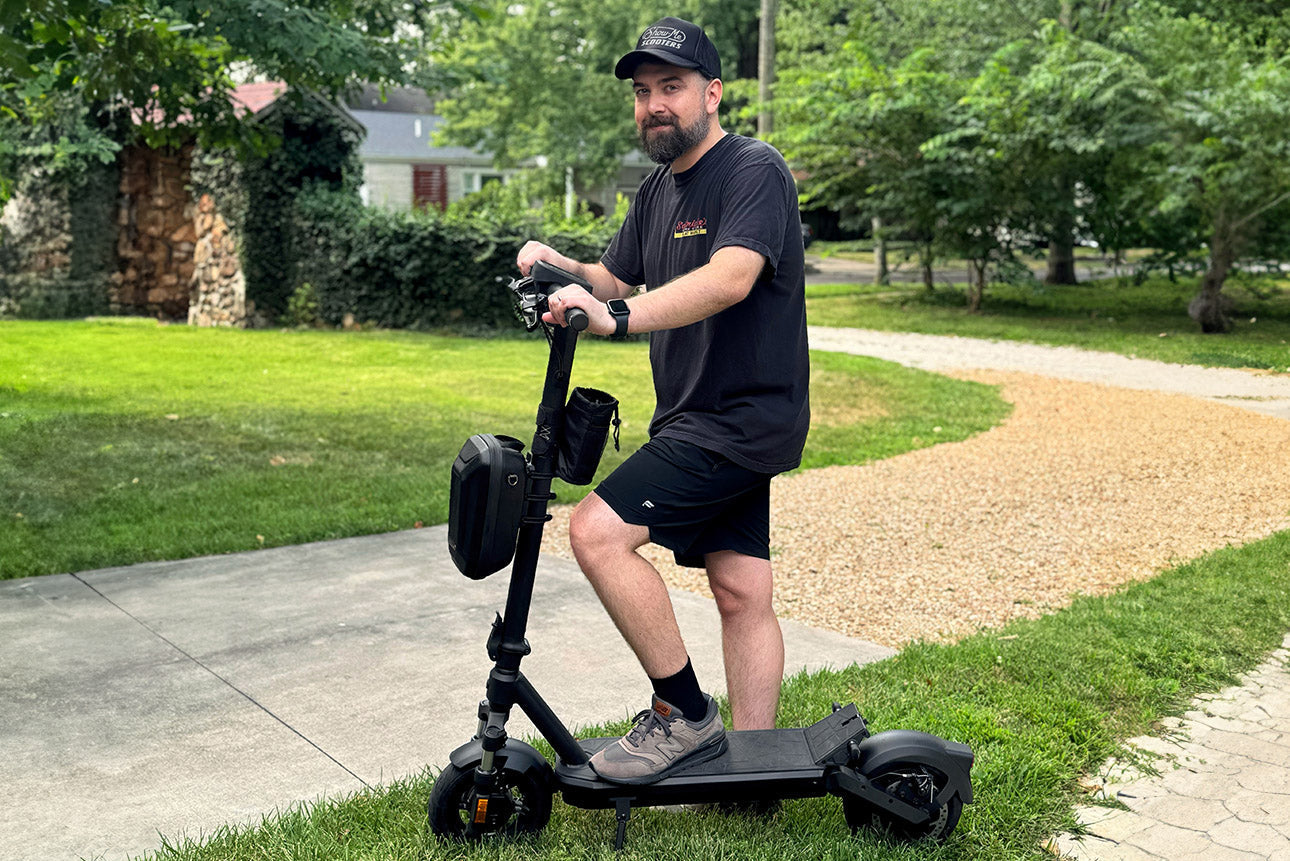

¡Nunca ha habido un mejor momento para comprar un scooter eléctrico para el desplazamiento! ¡Los precios de la gasolina han subido y los precios de los scooters han bajado!
No hace mucho tiempo tenías que gastar $999 o más para conseguir suspensión completa, buena capacidad de subir cuestas, neumáticos sin cámara y una calidad de construcción real para adultos. Ahora, scooters como el Segway Ninebot MAX G2 y el recién llegado VMAX VX2 Lite ofrecen calidad de conducción premium por solo $799.
Pero, ¿cuál es la mejor opción para el desplazamiento típico por la ciudad?
Para encontrar el mejor scooter para el dinero, probé nueve scooters eléctricos de desplazamiento populares de la misma manera que para velocidad máxima, autonomía, capacidad de subir cuestas, frenos y más. Utilicé el mismo curso de prueba de Electric Scooter Guide y los métodos que usé durante mis cuatro años como revisor principal de scooters en Electric Scooter Guide, donde probé más de 200 scooters eléctricos.
Cubriré los datos de los nueve scooters en esta publicación, pero dos se destacaron por ofrecer la mejor relación calidad-precio y calidad de conducción, así que me enfocaré principalmente en ellos: el Segway Ninebot MAX G2 y el nuevo VMAX VX2 Lite. ¿La buena noticia? Ambos tienen suspensión completa.
Ambos comienzan en $799. Ambos tienen suspensión completa y son súper fáciles de manejar, pero tienen personalidades y calidad de conducción muy diferentes.
El Ninebot MAX G2 es establecido, cargado de tecnología, y solo hay un tamaño de batería disponible (con buena autonomía).
El VX2 Lite es más nuevo, más rápido a 40 km/h, un poco más deportivo, y está diseñado para ofrecerte la calidad de conducción completa del más caro VX2 Hub a 55 km/h, pero sin tener que pagar por esa velocidad máxima adicional si no la necesitas. Además, viene en dos tamaños de batería: una versión de autonomía estándar con una batería de 499 Wh y una versión de larga autonomía con una enorme batería de 874 Wh, así que solo pagas por la autonomía que necesitas.
Entonces, ¿cuál deberías comprar? Eso depende de ti y tu estilo de conducción.
Veamos los datos de la prueba para saber cuál te conviene más.
- 1. Cómo Probé los Mejores Scooters Eléctricos para el Desplazamiento
- 2. Velocidad Máxima: El VX2 Lite es Notablemente Más Rápido
- 3. Autonomía en el Mundo Real: El Ninebot MAX G2 Hace un Regreso
- 4. Calidad de Conducción: Dos Enfoques Diferentes para la Comodidad
- 5. Subida de Cuestas: Ambos Son Fuertes, pero el VX2 Lite Gana
- 6. Frenado: Hardware Casi Idéntico, Resultados Ligeramente Diferentes
- 7. La App: Segway Gana Fácilmente
- 8. VX2 Lite vs. Ninebot MAX G2: Puntuación Final
- 9. ¿Qué Scooter Eléctrico para el Desplazamiento Deberías Comprar?
- 10. Conclusión
Cómo Probé los Mejores Scooters Eléctricos para el Desplazamiento
Cada scooter en esta comparación fue probado por el mismo piloto de 75 kg utilizando los mismos métodos de prueba.
Para probar la velocidad, hice pruebas en dos direcciones y promediar los resultados para reducir el efecto del viento en contra y la inclinación de la carretera.
Realicé pruebas de autonomía en el curso de pruebas de Electric Scooter Guide, montando cada scooter en su modo más rápido a velocidades urbanas normales.
La prueba de subida de cuestas utilizó una inclinación del 10%. Eso representa aproximadamente la colina más empinada que la mayoría de los ciclistas es probable que encuentren durante un desplazamiento normal.
Para el frenado, medí la distancia de detención desde 24 km/h hasta cero.
Para las pruebas, usé un registrador de datos VBOX Sport de $500, similar a lo que utilizan las revistas de automóviles, para capturar la aceleración y la velocidad de manera más precisa que las pantallas de scooter o la aplicación Dragy de bajo presupuesto que ves tan a menudo en reseñas de scooters en YouTube.
Revelación completa: Aunque el formato de prueba es 100% específico de Electric Scooter Guide, ahora trabajo para VMAX. Pero los datos siguen siendo los datos. Te mostraré dónde gana el VMAX, dónde gana el Segway y dónde la diferencia es demasiado pequeña para importar.

Velocidad Máxima: El VX2 Lite es Notablemente Más Rápido

El VMAX VX2 Lite alcanzó una velocidad máxima probada de 39,6 km/h.
El Ninebot MAX G2 alcanzó 34,4 km/h.
Eso le da al VX2 Lite una ventaja de velocidad máxima de 5,1 km/h.
Cinco kilómetros por hora pueden no sonar como una gran diferencia sobre el papel, pero es suficiente para hacer que el VX2 Lite se sienta más deportivo durante la conducción diaria. También se acerca a un kilómetro por hora de la velocidad máxima probada por ESG del más caro Apollo Go de motor dual.
Los gráficos de aceleración resultaron ser muy reveladores al moverte hacia los scooters de presupuesto. De hecho, es bastante impactante ver la diferencia en los tiempos de 0 a 24 km/h. En cada señal de alto y en cada luz roja, los scooters de presupuesto de $200 y $400 te dejan esperando pacientemente a que la velocidad regrese, mientras que los scooters premium te ofrecen un instantáneo "factor de aceleración" (y factor divertido) cuando la luz se pone verde.
Entre los dos scooters de $799, el VX2 Lite gana en velocidad y aceleración.
Ganador en velocidad máxima: VMAX VX2 Lite

Autonomía en el Mundo Real: El Ninebot MAX G2 Hace un Regreso

La autonomía es donde el Ninebot MAX G2 brilla.
En mi prueba, el G2 cubrió impresionantes 42,8 km. Pero necesito compartir una advertencia importante aquí. Segway extiende la autonomía limitando intencionadamente (y severamente) la velocidad máxima durante el último cuarto de la autonomía. Después de unos 34 km, la velocidad disminuyó drásticamente. El scooter completó los últimos cinco o seis kilómetros a menos de 16 km/h y ya no pudo subir cuestas, pero siguió avanzando mientras me mantuve en terreno plano.
El VX2 Lite de autonomía estándar cubrió 27 km, y la versión de larga autonomía cubrió 47,4 km. Ambos scooters mantuvieron la mayor parte de su velocidad y capacidad de subir cuestas hasta el final.
Los tamaños de batería son 499 Wh para el VX2 Lite de autonomía estándar de $799, 551 Wh para el Ninebot MAX G2 de $799, y 874 Wh para el VX2 Lite de larga autonomía de $1,099. Entonces, con los tamaños de batería siendo tan similares para los dos scooters de $799, ¿por qué el Ninebot MAX G2 llegó mucho más lejos? La respuesta es que el VX2 Lite iba un 24% más rápido. Parte de esto es debido a la desaceleración forzada del MAX G2 al final de la batería, y parte es debido a una aceleración más lenta y subida de cuestas. En resumen: el VX2 Lite me permitió ir más rápido en todas las condiciones si quería.
Si estamos comparando las versiones de $799 de ambos scooters, Segway se lleva la victoria en nuestra prueba de autonomía por los números. Pero si necesitas una larga autonomía y no quieres ser forzado a un modo lento al final de la batería, el VX2 Lite de larga autonomía podría ser la mejor opción.
Sin embargo, si tu desplazamiento es largo y la máxima autonomía por dólar es tu prioridad número uno, el Ninebot MAX G2 es difícil de superar.
Ganador en autonomía: Segway Ninebot MAX G2

Calidad de Conducción: Dos Enfoques Diferentes para la Comodidad
El Ninebot MAX G2 tiene una conducción muy cómoda y firme.
Utiliza suspensión hidráulica en la parte delantera y resortes ajustables en la trasera. La configuración es especialmente cómoda para ciclistas más ligeros que prefieren una suspensión más suave.
El VX2 Lite utiliza una horquilla de suspensión con aceite tipo motocicleta en la parte delantera. En la parte trasera, tiene la suspensión elastomérica patentada de VMAX, que actúa como un resorte y amortiguador en un solo sistema compacto.
Ese amortiguamiento es importante.
La suspensión no es automáticamente buena solo porque un scooter tenga resortes. Los resortes no amortiguados pueden hacer que un scooter rebote como un palo de pogo con ruedas. Después de todo, ¡los resortes no amortiguados son exactamente lo que hace que un palo de pogo rebote!
Una buena suspensión necesita un resorte para absorber el bache y un amortiguador para controlar el movimiento posterior para que no sigas rebotando para siempre. La suspensión completamente controlada en la parte delantera y trasera del scooter es lo que le da al VX2 Lite su sensación más controlada y deportiva.
No estoy declarando un ganador absoluto aquí porque el peso del ciclista y la preferencia personal importan.
Un ciclista más ligero que busque la configuración más suave posible puede preferir el MAX G2. Un ciclista más pesado o alguien que le guste una conducción más controlada y receptiva probablemente preferirá la suspensión del VX2 Lite y el hecho de que el VMAX tiene un límite de peso de ciclista más alto. Como ciclista de e-scooter experimentado y ex piloto de motociclismo, la suspensión del VX2 Lite es claramente una mejor opción para mi estilo de conducción deportivo.
La buena noticia es que ambos scooters ofrecen un nivel extraordinario de comodidad por $799. Solo hace unos años, era difícil encontrar una calidad de conducción como esta en un rango de precio similar.

Subida de Cuestas: Ambos Son Fuertes, pero el VX2 Lite Gana
La prueba de colina de Electric Scooter Guide tiene un grado del 10%. Representa la colina más empinada que la mayoría de los ciclistas se encontrarán durante un desplazamiento ordinario.
El Ninebot MAX G2 subió la colina en 13.1 segundos.
El VMAX VX2 Lite lo completó en 12.4 segundos.
Eso le da al VX2 Lite una ventaja de aproximadamente un 5%.
Este es un triunfo para VMAX, pero no es un nocaut. Ambos scooters son lo suficientemente fuertes como para subir casi cualquier colina que es probable que encuentres durante la conducción normal en la ciudad.
La lección más grande aparece cuando los comparas con los scooters genéricos más baratos.
La diferencia entre dos scooters premium de $799 es relativamente pequeña. La caída en el rendimiento de subida de cuestas cuando pasas a los scooters de $200 y $400 es mucho mayor.
Este es uno de los lugares donde gastar más te ofrece algo que realmente puedes sentir.
Ganador en subida de cuestas: VMAX VX2 Lite

Frenado: Hardware Casi Idéntico, Resultados Ligeramente Diferentes
El VX2 Lite y el Ninebot MAX G2 utilizan sistemas de frenado muy similares.
Ambos tienen un freno de tambor delantero y frenos regenerativos en la parte trasera. En ambos scooters, los frenos se controlan mediante una palanca en el manillar izquierdo que está conectada tanto a los frenos delanteros como a los traseros. El VX2 Lite tiene una palanca adicional solo para regeneración en el manillar derecho, lo que te da la opción de utilizar un 100% de frenado regenerativo para la conducción normal. Esto te proporciona la respuesta de frenado más suave y, por supuesto, carga tu batería cada vez que desaceleras o te detienes.
La razón por la que los frenos de tambor son tan populares en scooters de desplazamiento como el Ninebot MAX G2, así como en la mayoría de la línea de scooters Apollo, es que están cerrados, requieren poco mantenimiento y son menos agresivos que los frenos de disco, lo que los hace bien adecuados para el desplazamiento cotidiano. El frenado regenerativo reduce aún más el desgaste al utilizar el motor para desacelerar el scooter mientras devuelve energía a la batería.
Desde 24 km/h, el Ninebot MAX G2 se detuvo en 3.7 metros.
El VX2 Lite se detuvo en 3.5 metros, aproximadamente veinte centímetros menos.
Nuevamente, la diferencia no es enorme. Ambos scooters se detienen bien y ambos sistemas son muy fáciles de usar.
El VX2 Lite se lleva la victoria en datos, y también gana ofreciendo a los ciclistas la opción de usar una palanca de regeneración separada.
Ganador en frenado: VMAX VX2 Lite

La App: Segway Gana Fácilmente
Anunciemos primero al ganador obvio.
Segway gana en la categoría de aplicaciones.
La aplicación de Segway es extremadamente completa. Te permite ajustar un enorme número de configuraciones, personalizar el scooter y pasar horas explorando funciones.
Una gran aplicación puede ser una mezcla, sin embargo.
En el primer día, cuando sacas tu scooter de la caja, si eres como yo, quieres ensamblarlo e ir a montar de inmediato, ¿verdad?
Lo que no quiero hacer es pasar una hora creando una cuenta, navegando por los menús de la aplicación, viendo videos de seguridad, descubriendo cómo desactivar las funciones restrictivas, y, lo más importante, averiguando cómo desbloquear la velocidad máxima.
VMAX toma el enfoque opuesto. La aplicación es opcional porque el rendimiento completo del scooter y las configuraciones importantes se pueden acceder directamente a través de la pantalla. No necesitas crear una cuenta o conectar tu scooter para desbloquear su velocidad máxima. Tenemos un ajuste “secreto” de Modo Bestia para desbloquear la velocidad máxima, pero puedes desbloquearlo en menos de 15 segundos.
El enfoque de VMAX también ofrece una ventaja de privacidad para los ciclistas que no les gusta la idea de que las empresas de scooters rastreen los datos de conducción.
Algunos ciclistas llamarán al enfoque de VMAX menos avanzado. Otros lo llamarán menos intrusivo.
De cualquier manera, Segway ofrece más tecnología, por lo que el MAX G2 se lleva la victoria por la Mejor App.
Ganador de la Mejor App: Segway Ninebot MAX G2
VX2 Lite vs. Ninebot MAX G2: Puntuación Final
La puntuación final es:
VMAX VX2 Lite: 3
Segway Ninebot MAX G2: 2
El VX2 Lite gana en velocidad máxima, subida de cuestas y frenado.
El Ninebot MAX G2 gana en autonomía y tecnología.
La calidad de conducción es un empate porque la mejor opción depende del peso del ciclista y la preferencia personal.
¿Eso significa que todos deberían comprar el VMAX y nadie debería comprar el Segway?
Absolutamente no.
Esta comparación es honestly demasiado cercana para que un scooter sea el ganador universal. La elección correcta depende de lo que desees de tu desplazamiento.
Compra el Ninebot MAX G2 si deseas la máxima autonomía por dólar, la aplicación más completa, y un scooter establecido que se siente más relajado que emocionante.
Compra el VMAX VX2 Lite si deseas más velocidad, una conducción más deportiva, mejor suspensión amortiguada, y la mejor combinación de rendimiento, calidad de conducción y portabilidad que he probado a $799.
¿Qué Scooter Eléctrico para el Desplazamiento Deberías Comprar?
Los dos scooters de $799 pueden ser el punto dulce, pero en caso de que tu presupuesto y gusto por el rendimiento sean mayores (o menores), aquí está cómo los otros siete scooters de desplazamiento populares se desempeñaron en mis pruebas.
VMAX VX2 Hub: El Scooter de Desplazamiento de Nivel Experto
El VX2 Hub ofrece el rendimiento de muchos scooters de motor dual a través de un solo motor trasero.
Alcanzó una velocidad máxima probada de 54.8 km/h y casi 48 km de autonomía en el mundo real. Puede subir colinas extremadamente empinadas, pero la configuración de motor único mantiene la rueda delantera ligera y el manejo más natural (menos pesado) que muchos scooters de motor dual.
También es más fácil de levantar en un maletero o llevar escaleras arriba que los scooters de rendimiento más grandes.
El VX2 Hub es la elección para ciclistas experimentados que quieren un rendimiento de nivel experto sin renunciar a la practicidad para el desplazamiento.
Segway Ninebot MAX G3: La Opción de Alta Tecnología
El MAX G3 alcanzó 44.8 km/h en mi prueba y es uno de los scooters de desplazamiento más tecnológicamente avanzados disponibles, con una aplicación aún más profunda que la del Ninebot MAX G2.
Su autonomía real fue de 35 km. Similar a su hermano, el MAX G2, la velocidad del G3 fue severamente limitada durante un gran trecho de la prueba de autonomía. Hacia el final, la velocidad máxima se limitó a tan solo 11 km/h durante varios kilómetros, lo cual es lo suficientemente lento como para ser embarazoso en la pista para bicicletas, pero sigue siendo mejor que empujar a casa, supongo.
La batería externa disponible podría abordar esa debilidad, pero ha sido extremadamente difícil encontrarla en stock. Literalmente, cada vez que he verificado el sitio de Segway, la batería externa se ha agotado. Algo más que es muy importante saber sobre la batería externa es que no es algo que puedas usar mientras conduces. Sí, lo leíste correctamente. Es un banco de energía que solo funciona cuando el scooter no se está moviendo. Así que, supongo que puedes usarla para cargar mientras tomas un café en algún lugar, pero podrías hacer lo mismo con un cable de alimentación.
El MAX G3 es un scooter capaz y definitivamente un digno sucesor del Ninebot MAX G2. La gente lo compra porque ama la tecnología y el estilo moderno, y porque se considera una elección “segura”, especialmente para aquellos ya en el ecosistema de Segway; no porque ofrezca la mayor autonomía o rendimiento por dólar.
VMAX VX2 Pro GT: Potencia Sin el Peso de la Suspensión
El VX2 Pro GT ha sido uno de los scooters más vendidos de VMAX durante años porque ofrece más de lo que su precio sugiere en calidad de conducción, rendimiento y autonomía.
Alcanza 39.6 km/h, sube colinas bien, y sigue siendo más fácil de llevar y encajar en un maletero que un scooter de suspensión completa.
Sus neumáticos neumáticos tubeless de 10 pulgadas ofrecen una conducción sorprendentemente suave a pesar de la falta de suspensión.
Elige el VX2 Pro GT si la portabilidad es más importante para ti que la suspensión completa, y si quieres un scooter suizo sólido con un rendimiento que aplasta al original Ninebot MAX G30.

Apollo Go: Compacto, Deportivo y Premium
Probé el Apollo Go cuando estaba en Electric Scooter Guide, y lo que me gustó de él fue que Apollo convirtió todas sus mejores características en el factor de forma más compacto posible y le dio motores duales.
El Apollo Go que probé en ESG alcanzó 40.8 km/h en lugar de su anunciada velocidad de 45 km/h, pero su calidad de construcción y calidad de conducción fueron excelentes. Me han dicho que la aplicación de Apollo se ha actualizado desde mi revisión y que ahora permite desbloquear la verdadera velocidad máxima, pero aún no he podido verificar eso con equipo de prueba.
Con el Go, no obtienes el rendimiento bruto por dólar de algunos scooters potentes genéricos como Kukirin o Yume, pero si compras un Apollo, el rendimiento “bruto” no es lo que estás buscando. Lo que obtienes en su lugar es mucho como lo que obtienes con Segway y VMAX: un scooter refinado y premium donde cada detalle ha sido cuidadosamente revisado por los ingenieros antes de su lanzamiento.
¿Deberías comprar el Apollo Go? Eso depende de cuán deportivo quieres que se sienta tu scooter. El Go es extremadamente lujoso. Clasificados de más deportivos a más relajados, los pondría en este orden: 1) VX2 Lite, 2) Apollo Go, y 3) Ninebot MAX G2. Los tres scooters son fáciles de manejar e ideales tanto para ciclistas nuevos como intermedios.
Costco Phantom GoGo A10: Más Grande, Pero Quizás No Mejor
Compré el Phantom GoGo A10 en Costco por $399 y lo probé de la misma manera que los otros scooters.
Alcanzó 24.6 km/h y cubrió 22.8 km.
Los neumáticos parecen anchos, lo que me dio esperanza de que la conducción sería más suave que la de otros scooters de mejor venta de neumáticos sólidos que he probado, pero son extremadamente firmes. Mirando más de cerca la parte trasera del scooter, encontré otra fuente de decepción. Lo que parece ser un brazo oscilante, insinuando suspensión trasera, en realidad no es suspensión en absoluto. La calidad de conducción resultante fue nerviosa, temblorosa y, en general, decepcionante.
El gran punto a favor del Phantom GoGo A10 de Costco en comparación con el scooter Maxshot de Amazon que te contaré a continuación es que el scooter de Costco se siente mucho más espacioso y adecuado para adultos. Pero el rendimiento del scooter de Costco simplemente no justifica el peso extra y el doble del precio del scooter que viene a continuación.

Maxshot V1 Sportscooter (comprado en Amazon): Transporte por Menos de $200
En el momento en que lo compré, el Maxshot V1 Sportscooter era el scooter eléctrico más vendido en Amazon.
En la prueba, alcanzó 29 km/h, cubrió 19.5 km, y hasta subió la colina de prueba de Electric Scooter Guide, aunque apenas.
La calidad de conducción se puede resumir en una palabra: horrible. Pero dejando de lado por un momento el hecho de que la conducción es tan temblorosa que tu visión se vuelve borrosa en caminos irregulares, es admirable cuánto transporte ofrece este scooter por $199.
Pero la lista de compromisos crece rápidamente: neumáticos sólidos, sin suspensión, tracción limitada, manillares bajos, frenado regenerativo agresivo, y una distancia de frenado casi el doble que la de los mejores scooters de este test. En conjunto, estos compromisos hacen que el Maxshot sea menos agradable de manejar que cualquier otro scooter en esta lista y, debido a su mayor distancia de frenado y tracción limitada, también un poco menos seguro.
También debes suponer que las piezas y el soporte al cliente serán inexistentes con marcas genéricas de Amazon. La mejor manera de verificar esto de antemano es visitando rápidamente el sitio web del fabricante. En el momento de la publicación de este artículo, el sitio web de Maxshot ofrece exactamente cero piezas de repuesto a la venta. Por lo tanto, están vendiendo un scooter esencialmente desechable; ¡pero por favor recíclalo si llega a eso!
Compra el Maxshot V1 Sportscooter, el más vendido de Amazon, solo si tu objetivo es gastar lo menos posible y viajar distancias cortas. Si compras uno, recuerda guardar la caja y probarlo a fondo durante la ventana de devolución de 30 días, porque esa puede ser la única atención al cliente disponible para el scooter de $199.
Conclusión
Así que ahí tienes el fondo de la lista. Vamos a terminar con los mejores scooters por menos de $800. Para mí, el Segway Ninebot MAX G2 y el VMAX VX2 Lite ocupan el punto dulce absoluto en cuanto a valor de scooters de desplazamiento con suspensión completa.
Ambos ofrecen una calidad de conducción que se siente sorprendentemente de alta gama, con suspensión completa, neumáticos sin cámara, frenos confiables, ergonomía adecuada para adultos, y el tipo de calidad de construcción que te permite seguir montando durante años en lugar de quedarte pequeño para el scooter después de unos meses.
El Ninebot MAX G2 es la mejor opción para ciclistas que priorizan la autonomía, las características de la aplicación, y una plataforma establecida.
El VMAX VX2 Lite es la mejor opción para ciclistas que disfrutan del diseño suizo y que quieren una ventaja en cuanto a rendimiento, manejo y subida de cuestas, además de una personalidad un poco más deportiva en general. Para ponerlo en términos automovilísticos, si el MAX G2 fuera un Acura Integra, el VX2 Lite sería un BMW M340i, y el VX2 Hub sería un BMW M3.
Es difícil equivocarse con cualquiera de los Ninebot MAX G2 o el VX2 Lite. Cualquiera de los dos haría muy feliz a la gran mayoría de ciclistas a largo plazo. Pero para mi estilo de conducción, elegiría el VX2 Lite. Te ofrece una calidad de conducción que se siente un poco más premium. De hecho, es la misma calidad de conducción que obtienes con nuestro VX2 Hub en la mejor especificación, pero a aproximadamente la mitad del precio inicial. Con el VX2 Lite, los ciclistas que no quieran ir a 54.8 km/h ya no tienen que pagar por un rendimiento que no necesitan.
Eso es lo que hace especial al VX2 Lite.
No está intentando ser el scooter más rápido ni el de mayor autonomía en el mundo.
La misión del VX2 Lite es ofrecer la mejor combinación de velocidad, comodidad, portabilidad y calidad de conducción diseñada suiza que puedas obtener por $799 y hacerla accesible para todos, no solo en precio, sino también en estilo de conducción. El acelerador del VX2 Lite es completamente amigable para los nuevos ciclistas, pero tiene suficiente “deporte” para que los ciclistas intermedios encuentren el factor divertido en cada paseo.
Según los resultados de las pruebas y lo que estamos escuchando de los nuevos clientes, el VX2 Lite ha dado en el blanco.
Conducción Premium. Precio Ligero.
Conduce seguro, y no olvides usar casco.